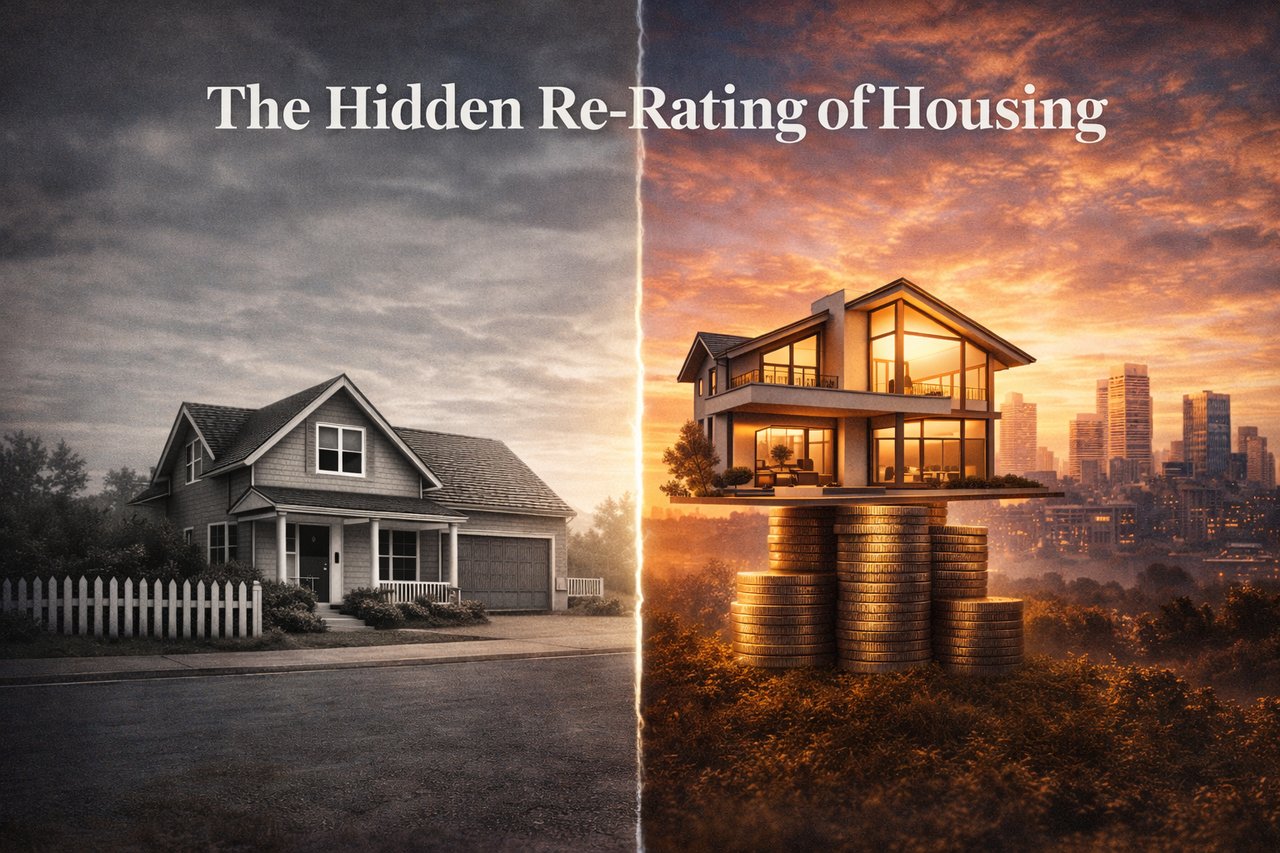
A fundamental shift has occurred in real estate, and I don’t think it’s being fully accounted for in how many people evaluate housing today.
When people talk about the rise in housing prices over the last several years, the conversation usually centers around the same explanations: market cycles, supply shortages, or fears of another bubble similar to 2008. The debate often focuses on whether prices are unsustainably high and when they might correct.
But I think that assumption may be missing something deeper.
The question isn’t simply why housing became more expensive. The more important question is what actually drove the surge in demand beneath the surface.
Yes, supply constraints played a role. Yes, demand increased. But what fundamentally changed was how housing itself is valued.
In the years following COVID, a shift occurred in how people interact with physical space. Work moved into the home. Technology blurred the line between personal and professional environments. At the same time, platforms that allow people to monetize property—from short-term rentals to digital content—expanded the ways a single home could generate economic value.
Historically, housing represented stability. For much of the twentieth century, a home was closely tied to family structure, permanence, and long-term living. The value of a house was largely based on its role as shelter and the traditional fundamentals surrounding it.
Today, a home can represent something much broader.
A single property can now function as shelter, an income-producing rental, a short-term hospitality business, a workspace, a creative studio, or even a marketing platform. In many cases, it can generate multiple forms of economic value simultaneously.
When the number of ways an asset can produce value increases, the way the market prices that asset changes.
Markets naturally place higher valuations on assets that can produce income or support multiple forms of activity. A home that can host a business, generate content, support remote work, and create income streams is fundamentally different from a home that serves only as shelter.
And it isn’t just short-term rentals driving this shift.
Housing is increasingly being used for multigenerational living, hybrid work environments, and flexible living arrangements that were far less common in the past. Homes are accommodating businesses, content creation, remote work, and extended families under one roof.
Each of those uses adds another layer of value.
At the same time, consumer expectations around housing have also been evolving in ways that were already happening quietly before COVID.
Over the past decade, many people—especially younger generations—have begun placing a greater emphasis on flexibility, mobility, and experiences over traditional long-term stability. Travel, lifestyle, and the ability to move freely have become increasingly important priorities.
Rather than tying up resources exclusively in a primary residence, many people prefer to allocate more of their income toward travel, experiences, and flexible living arrangements. This shift in priorities has led some to favor renting in high-amenity environments while maintaining the freedom to relocate, travel, or pursue opportunities elsewhere.
This behavioral shift was already forming under the surface before COVID. The pandemic simply accelerated it.
As remote work expanded and mobility increased, people gained the ability to live, travel, and work in ways that were far less common before. Housing began serving not just as a permanent residence, but as a flexible base for lifestyle, work, and investment.
At the same time, consumer expectations around housing have also changed. The modern buyer is not simply looking for stability and a backyard. Many people now prioritize amenities, design, experience, and community.
What we’re seeing is a tug-of-war between two different models of housing.
One model reflects the pre-COVID view of housing: stability, permanence, and traditional ownership.
The other reflects a newer view that has accelerated in the post-COVID era: housing as a flexible, income-producing, lifestyle-driven asset.
When a market begins valuing an asset differently, the price multiple attached to that asset changes. What we may be witnessing in real estate is not simply a temporary spike in prices, but a re-rating driven by a fundamental shift in how housing is used and perceived.
Markets are constantly trying to interpret the present using frameworks built in the past. Housing will continue to move through cycles, and periods of slowdown are inevitable. But the way people live, work, travel, and generate income has changed in meaningful ways since COVID, and those behavioral shifts have altered how housing is used and valued.
When the function of an asset evolves, the way the market prices that asset tends to evolve with it.
What we may be witnessing today is not simply a housing market that became temporarily overheated, but one that is slowly settling into a different valuation framework than the one that existed before the pandemic.